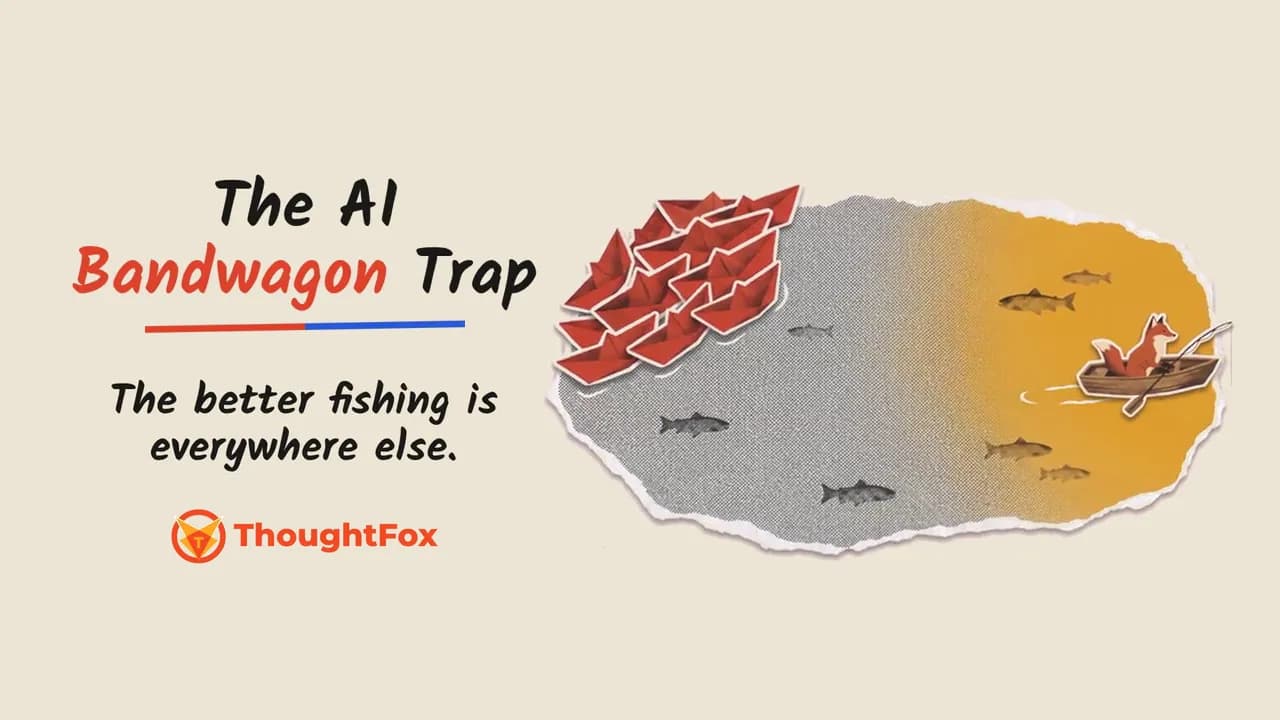
Picture a lake with a fishing app. Someone lands a big catch, the app shows the spot to everyone, and within an hour a hundred boats are crammed into the same corner. The fish scatter. Nobody catches much. Meanwhile the rest of the lake sits quiet and full.
That's increasingly how business ideas spread. Platforms like LinkedIn decide what you see, and they push whatever is already getting attention. A handful of ideas get amplified until they look like what everyone is doing. Leaders see them everywhere, worry they're falling behind, and jump on the bandwagon. The approach gets crowded and generic, and stops working, while the options nobody is talking about go unexplored.
Nowhere is this playing out more clearly than in AI.
AI has two bandwagons, and both are traps
If you run a mid-market business in the real economy (manufacturing, distribution, construction, logistics, services with real operations behind them), social media and your network are probably telling you two stories about AI at once.
Bandwagon one: "Everyone's doing it." Buy the licences. Put a chatbot on the website. Announce an AI strategy. Nobody wants to be the business that missed it.
Bandwagon two: "It doesn't work." The headlines that most AI pilots fail. The stories of made-up answers, wasted spend, projects quietly shelved. Better to wait until it settles down.
These sound like opposites. They're actually the same behaviour. Both let whatever is popular online strongly influence the decision. One pulls you towards copying what's visible; the other keeps you standing still because that's what the cautious crowd is doing.
And both miss where the value actually is.
What bandwagon AI looks like
We see the pattern regularly. A business buys a batch of AI assistant licences because a competitor did. A few enthusiasts use them well. Most people try it twice, get a generic answer, and go back to how they worked before. Six months later the renewal comes up and nobody can say what it delivered.
That's not an AI failure. It's a bandwagon failure. The tool was chosen because it was visible, not because it was pointed at a problem worth solving.
Here's the irony: the AI moves that get the most airtime are the ones least likely to give you an edge. If every firm in your sector bolts on the same generic tool, it becomes the new baseline. Useful, maybe. Differentiating, no.
Where the crowd isn't looking
The valuable AI work in real-economy businesses rarely makes for a good post. Nobody goes viral for fixing quote turnaround. But that's exactly where it lives:
These are unglamorous. They're also specific to you: your processes, your data, your customers, your people's hard-won know-how. That's the part no competitor can copy from a LinkedIn post, and it's where AI value builds on itself.
So should you jump? Yes. Just not where the crowd is.
Waiting isn't neutral. While you wait for the noise to settle, the businesses that quietly get one workflow working are building something harder to catch than a licence count: people who know how to use AI in their jobs, and systems built around how the business actually runs.
The question isn't whether to jump in. It's how to jump in without following the herd. Five filters we use with clients:
1. Walk the value chain before you pick a workflow. Not every workflow is worth fixing, so start by walking the whole chain, from first enquiry through to delivery and invoice. The biggest costs usually hide in the handovers: where work passes between departments, gets re-keyed, waits in an inbox or loses context along the way. Look for the workflows and handovers that are costing real time and money, that are blocking new ideas, that get in the way of serving customers better, or that could open up an entirely new revenue channel if they ran differently. Only then ask which tool fits.
2. Look for boring, repetitive and expensive. The best first projects are rarely exciting. They're the hours spent re-keying, searching, summarising and chasing. Measure them before you touch them, so you can prove the difference after. The drop-off points where work passes between teams and functions are a different kind of opportunity. Fixing them means rethinking how work flows across the business, so they're usually a later, more strategic initiative, but often where the biggest returns sit.
3. Tie it to a number the board cares about. Efficiency, team capacity, speed of decisions, customer experience, risk. If a project doesn't move one of them, it's a demo, not a strategy.
4. Bring the people who do the work. AI adoption is roughly 70% people and process, 30% technology. The person doing the job knows where the real friction is, and if they help design the change, they'll use it. Resistance is useful signal: it tells you where adoption will break.
5. Build the guardrails in from day one. If your teams use AI at work, you're a "deployer" under the EU AI Act, and the AI literacy obligation has applied since February 2025. Good governance isn't a brake. It's what lets you scale with confidence.
Think for yourself, then move
The lesson is simple: think broadly and critically about your options, and don't let what's popular online strongly influence the decision.
For mid-market leaders, that means neither copying the loudest AI story nor waiting for the quietest one. It means looking at your own business, finding the two or three workflows where AI would genuinely change the numbers, and building working systems there, not pilots stuck in purgatory.
The corner of the lake with all the boats is easy to find. The better fishing is everywhere else.
ThoughtFox helps mid-sized organisations turn AI strategy into working systems that show up in the numbers, with the knowledge transferred to your team rather than locked in with us.
Found this useful?
Share on LinkedIn