
The AI Automation of Your Workflows Worked Perfectly (and That's Exactly What Went Wrong)
Most organisations have never examined the gap between what they believe their work should achieve and what their operations actually reward. AI doesn't close that gap. It makes it visible.

Take customer service. Every organisation will tell you they're optimised to deliver maximum customer value. But look at how the work actually runs: contact centres measured on handle time, escalation paths designed to deflect, systems that don't talk to each other.
Those aren't the conditions for delivering customer value. They're the conditions for managing cost.
The contradiction has always existed. Humans navigated it daily with judgment, experience, and a quiet understanding of what the business actually needed in that moment.
Add smart automation to that without examining it first, and you don't solve the problem. You scale it. Consistently. At speed. Before anyone notices.
Most organisations have never examined the gap between what they philosophically believe their work should achieve and what their operations actually reward.
AI doesn't close that gap. It makes it visible, usually at the worst possible moment.
The answer isn't a technical fix. It's establishing (before anything is built) what this organisation will never compromise on, regardless of what the metrics say.
At ThoughtFox, that's one of the first questions we ask before any engagement begins. It's the foundation of our PRIME framework. Because until you can answer it honestly, you're not ready to automate anything.
What is your work actually optimised for right now, and does it reflect what you intend?
More from the blog
 Blog · Leadership & Strategy, Value & Outcomes
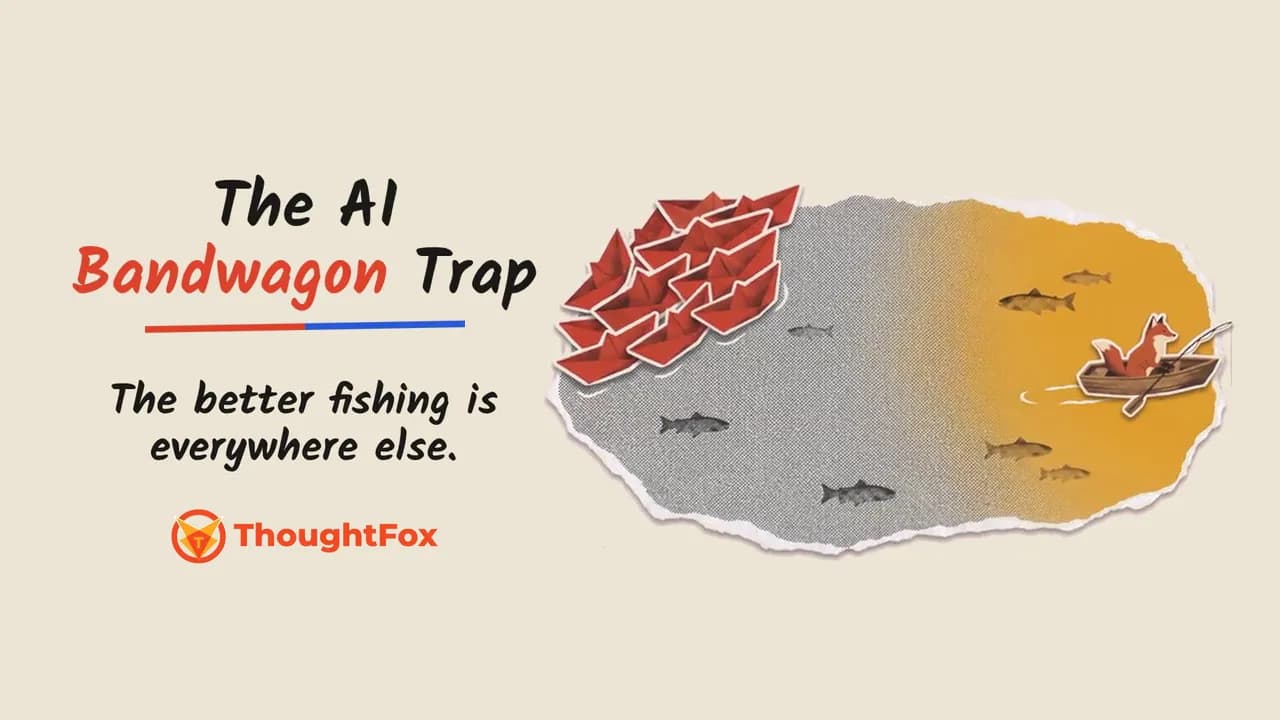
The AI Bandwagon Trap
The AI moves that get the most airtime rarely give you an edge. Five filters for mid-market leaders to find the AI workflows the crowd is missing.
 Blog · Leadership & Strategy
Why AI Pilots Stall, and What to Do Before the Build Begins
Most AI pilots don't fail because of the technology. They stall because nobody mapped the failure points before the build began.
 Blog · Leadership & Strategy
The 3 Types of AI Your Board Will Ask About
AI isn't one thing. In enterprise settings, it plays three distinct roles: the Analyst, the Creator, and the Worker. Confusing them creates misaligned expectations from the start.
Not sure where to start? That’s the right time to call.
Whether you have licences, pilots or nothing yet, we’ll help you pick a sensible first step.