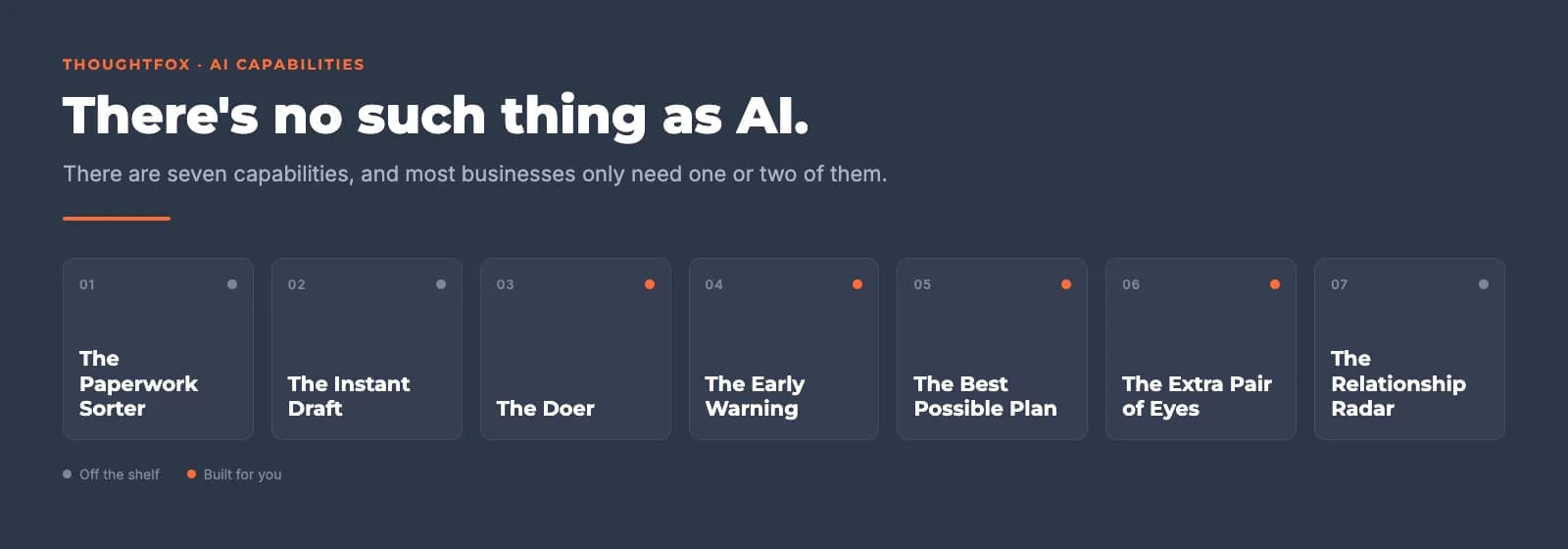
"AI" has become shorthand for everything from a chatbot to a warehouse robot to a fraud-detection model, which means, on its own, it no longer means anything specific. When someone tells us they want "some AI," they are almost never describing a technology. They are describing a business problem, and that problem happens to be solvable by any one of seven genuinely different capabilities, each with its own cost, its own risk, and its own route to payback.
So we split it up. What follows is the toolkit in plain English: what each piece actually does, the problem it earns its keep on, and whether it is something you plug in this quarter or something we build around your business specifically.
The word "AI" stopped meaning anything a while ago
Ask ten people in a boardroom what "the AI project" should do and you will get ten different answers, because the phrase does no useful work on its own. A generative model that drafts a policy document and a computer-vision system that spots a missing hard hat on a site camera are both, technically, "AI." They have almost nothing else in common: different data, a different risk profile, a different team needed to build them, and a different reason a business would pay for either one.
That ambiguity is not a semantic quibble. It is where AI budgets go to die. A leadership team agrees to "invest in AI," a vendor sells them a chatbot, and eighteen months later nobody can explain why the scheduling problem that started the conversation is still unsolved. The chatbot was never going to fix a scheduling problem. Wrong tool, sold under the right buzzword.
We deal with this by refusing to talk about "AI" as a single thing. Underneath the word sit seven distinct capabilities. A business rarely needs more than one or two of them at a time. The job is working out which.
The toolkit, in plain English
01: The Paperwork Sorter (AI Automation)
Feed it the messy stuff, PDFs, emails, scanned delivery notes, and it comes back as clean, usable data. No re-typing, no chasing.
02: The Instant Draft (Generative AI)
Reads everything you've already got, then writes, illustrates, summarises or answers back in plain English. A first draft in seconds instead of hours.
03: The Doer (Agentic AI)
Doesn't just answer the question. It goes and finishes the multi-step task itself, moving between the systems it needs to get there.
04: The Early Warning (Predictive AI)
Looks at what's happened before to tell you what's coming next, before it turns into a breakdown, a stock-out, or a missed target.
05: The Best Possible Plan (Optimisation & Prescriptive AI)
Works out the single most efficient way to allocate people, vehicles or time, a calculation too large to do by hand or by gut feel.
06: The Extra Pair of Eyes (Computer Vision)
Watches video or images continuously and flags what a person would, a missing hard hat, a defect on the line, without ever getting tired or distracted.
07: The Relationship Radar (Conversational Intelligence)
Listens to calls and messages at scale to pick up tone, intent and risk, the things a manager would notice, if they could sit in on every single call.
Read that list back and notice what's missing: a running order. These are seven parallel capabilities, not stages of a pipeline. Most businesses need one or two of them, almost never all seven at once.
Two ways we build it
Every one of the seven above gets delivered one of two ways.
Off the shelf means it plugs into tools that already exist, sometimes inside software you're already paying for, sometimes as a specialist point solution built to do exactly one of the seven jobs well. The generative-AI work tends to follow whichever ecosystem you're already in: Microsoft Copilot if you live in Outlook, Teams and SharePoint, Google Gemini if you're a Workspace shop, or, for plenty of businesses, an independent model like ChatGPT or Claude running outside either one. We work across all of them; we're not backing one horse. The paperwork-sorting work is usually a dedicated point solution regardless of ecosystem, Azure AI Document Intelligence, Rossum or Docsumo reading an invoice and pushing clean data straight into finance. And the relationship-radar work is its own category again: Apollo.io doing the lead-enrichment version of it before anyone picks up the phone. Either way, it's cheaper and faster to stand up than building your own, because you're renting someone else's engine.
Built for you means purpose-built around your process specifically: the route-scheduling engine, the site-camera model, the procurement agent. The obvious reason it's worth the extra time and cost is differentiation: if it's the thing that actually sets you apart, buying the same tool every competitor can buy erases the edge before you've switched it on.
The less obvious reason is compounding. Wire it into a shared company-knowledge layer instead of a vendor's black box, and every invoice it reads, every call it listens to, makes every other AI system in the business a little smarter over time. Buy the commodity version instead, and whatever it learns may stay locked inside that vendor's product. It makes their tool better, not the rest of your AI stack.
Then there's sovereignty, the system, and everything it learns from your data, belongs to you outright, which matters most when the workflow is unusual enough that no off-the-shelf tool fits without a workaround, when a decision needs to be explainable to a regulator, or when a per-seat price that looked cheap in the pilot starts creeping at real scale.
The question we ask before choosing either: would this be a commodity tomorrow even if every competitor had it too? If yes, buy it off the shelf and move on. If it's the thing that actually differentiates you, or the thing that should be compounding your company's own knowledge rather than someone else's, build it.
We diagnose first. The technology comes second.
When a client says "we want to explore AI," that's not a brief. It's an opening question. The conversation that actually matters is what's slow, risky or manual in the business right now, and which one or two of the seven above earns its keep against that specific problem.
It doesn't change much whether you're running a factory floor, a haulage fleet, a maintenance contract or a construction site: make, move, maintain or build. The shape of the conversation is the same. Find the bottleneck first, then reach into the toolkit for the piece that fits.
We don't start with the technology. We start with the problem.
Frequently asked questions
What are the seven types of AI capabilities for business?
AI Automation (turning messy documents into clean data), Generative AI (drafting and summarising text), Agentic AI (completing multi-step tasks across systems on its own), Predictive AI (forecasting from historical data), Optimisation & Prescriptive AI (working out the most efficient allocation of people, vehicles or time), Computer Vision (interpreting images and video), and Conversational Intelligence (analysing calls and messages for tone and intent). Most businesses only need one or two of the seven at any given time, not all seven at once.
What's the difference between off-the-shelf and custom-built AI?
Off-the-shelf AI plugs into a tool you already pay for, or a specialist point solution built to do one job well, and is cheaper and faster to stand up because you're renting someone else's engine. Custom-built AI is purpose-built around your specific process. It costs more and takes longer, but it's worth it when the capability differentiates you, when it should feed a shared company-knowledge layer rather than a vendor's product, or when the workflow is too unusual for an off-the-shelf tool to fit.
Does using commercial AI tools like Microsoft Copilot mean the vendor trains its models on our data?
For serious enterprise vendors, generally no. Microsoft's own documentation states that Microsoft 365 Copilot prompts, responses and Microsoft Graph data are not used to train the underlying foundation models. The more relevant limitation for most businesses isn't model training, it's that whatever the tool learns may stay locked inside that vendor's product rather than feeding the rest of your own AI stack.
Is agentic AI the same as generative AI?
No. Generative AI drafts, summarises or answers in natural language, but a person still has to act on the output. Agentic AI goes further: it carries out a multi-step task itself, moving between the systems it needs to finish the job, such as an agent that handles procurement end to end rather than just drafting a purchase order.
How do I decide which AI capability my business actually needs?
Start with the problem, not the technology. Identify what's slow, risky or manual in the business right now, then work out which one or two of the seven capabilities actually addresses it. Most problems only need one or two, never all seven at once.
Ready to work out which of the seven your business actually needs? Get in touch.