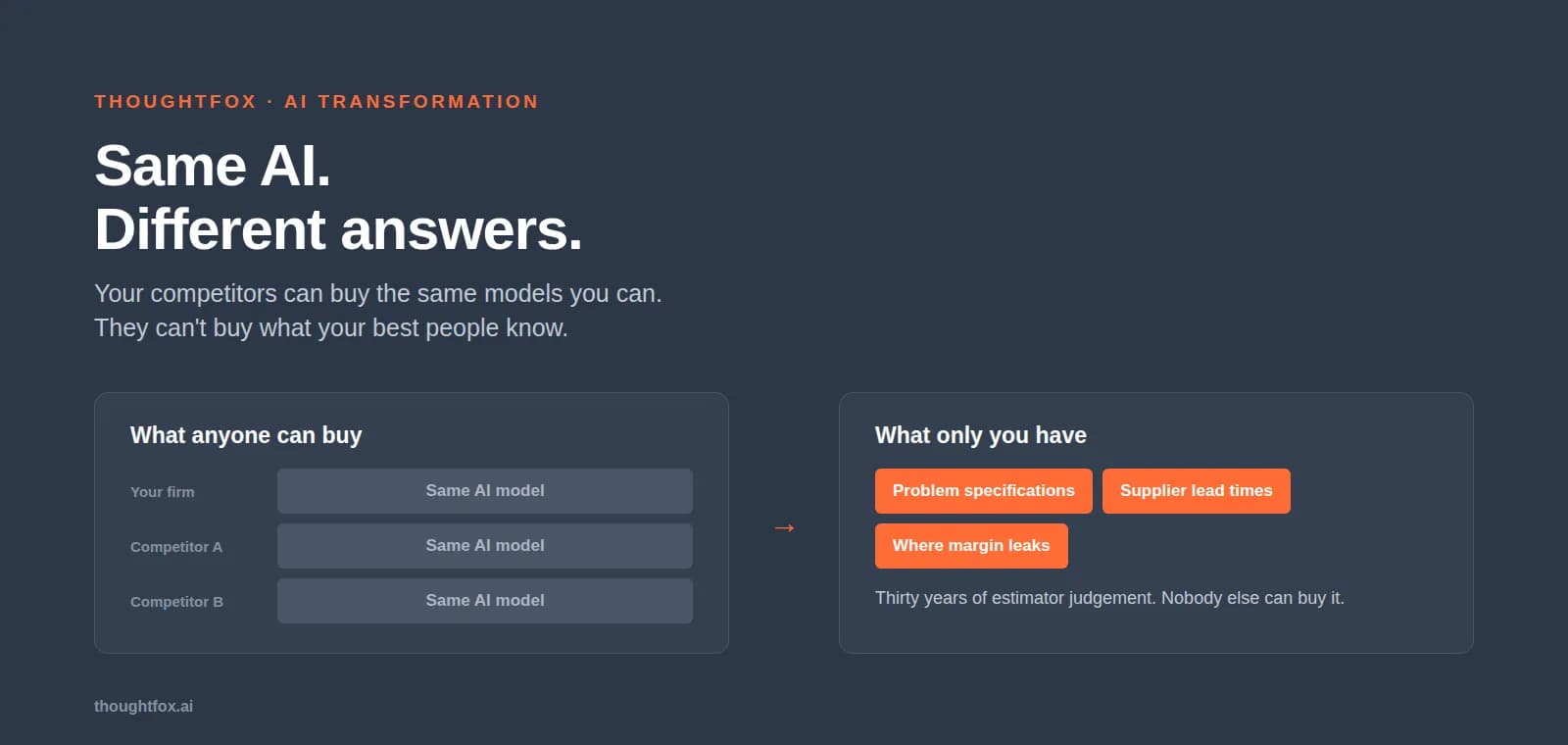
Your competitors can buy the same AI as you. They can't buy what your best people know, and most firms never put that knowledge to work.
The tenders you never bid on
Picture a mid-sized manufacturer of engineered building products that wins most of its work through tenders. Its order book depends on two senior estimators with 30 years of experience between them.
They know which specifications cause trouble on site, which suppliers slip on lead times, and where margin quietly leaks on certain project types. None of this is written down in any system. It lives in their heads, their notebooks and a handful of spreadsheets only they understand.
Every tender queues for their time. In busy months, some aren't bid at all, and the business has no way of knowing what it lost.
Ask the managing director what AI could do for the company, and the answer is usually a list of tools: a chatbot for customer queries, Copilot licences for the office, perhaps a pilot in the finance team. The estimators rarely come up. Yet that queue is where the biggest opportunity sits.
Same AI, different answers
A lesson from a very different industry shows why. Harvey is a software company that sells AI tools to law firms, and it has grown quickly: more than 100,000 lawyers now use it.
Harvey once promoted a specialist AI model, built with OpenAI and trained on case law, as part of what set it apart. Within about a year, general-purpose AI models had caught up. By May 2025, Harvey reported that seven off-the-shelf models outperformed the system it had originally tested on its own legal benchmark, so it began offering models from Anthropic and Google alongside OpenAI's.
You might expect that to have hurt the business, but the model turned out not to be the main thing customers valued. Harvey works closely with its clients, often through its own legal engineers (experienced lawyers who work alongside client teams), to turn each firm's recurring tasks into step-by-step routines that run on the AI and connect to the systems the firm already uses.
The result is that rival firms use the same product but get different results. Reviewing a non-disclosure agreement is a good example. Any AI can summarise one. A routine built by a particular firm checks every clause against that firm's own standards, flags what its partners would refuse, and suggests changes in its house wording. Two competitors, same tool, different answers.
The same applies in manufacturing. Your competitors can buy the same AI models as you, from the same suppliers, at the same price. What they cannot buy is your estimators' judgement. Harvey's clients have Harvey's legal engineers to help capture that kind of judgement. Most mid-sized manufacturers have no one in that role, which is why it so rarely gets done.
Two jobs, and most firms skip the first
For the manufacturer, the equivalent is a tender-checking routine built from the estimators' own knowledge. It reads each incoming tender, flags the specifications the estimators know cause problems, prices materials against the company's own supplier history, and drafts a quote in the usual format. The estimators then review it, adjust it and sign it off.
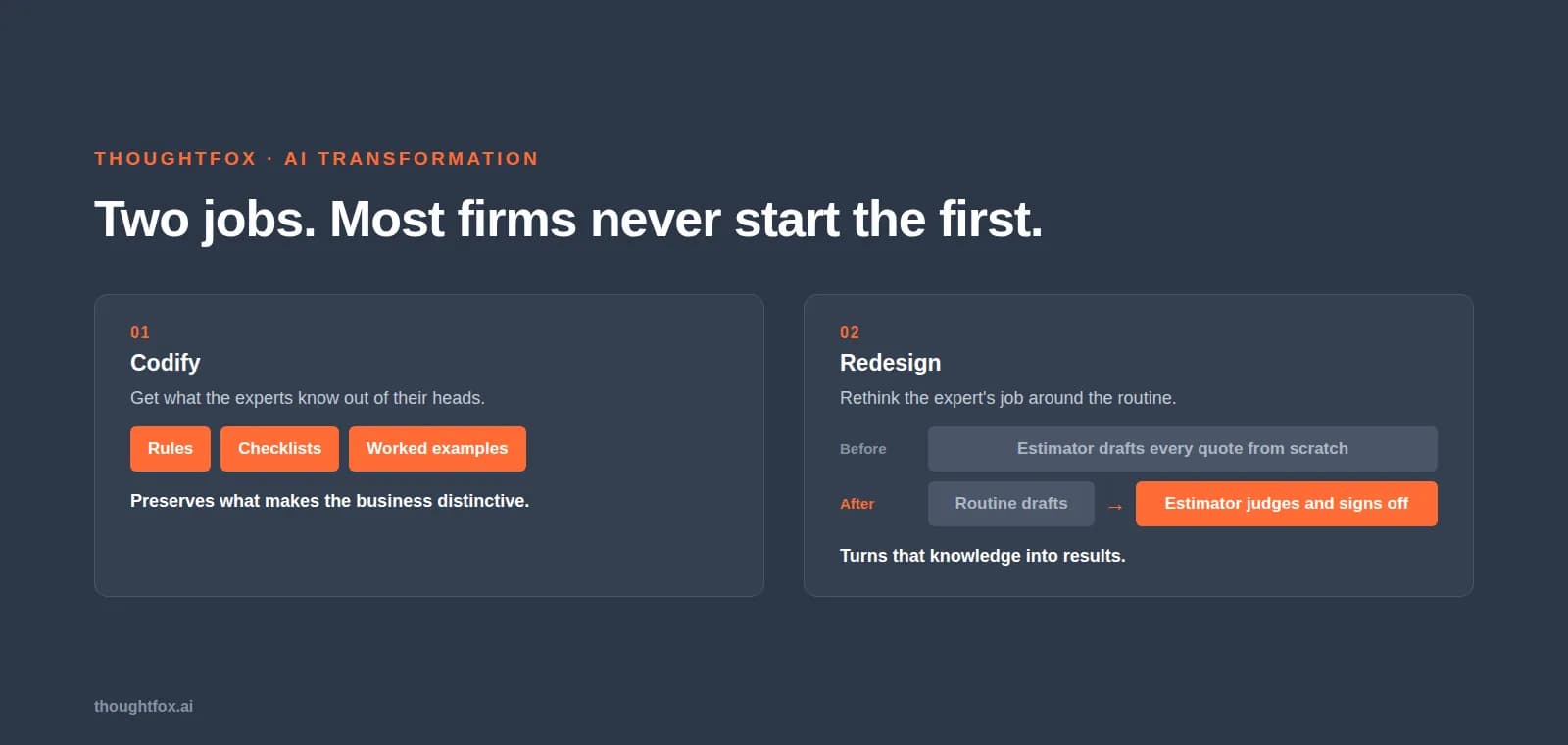
Getting there involves two distinct jobs, and most companies never even start the first.
The first is codifying: getting what the estimators know out of their heads and into rules, checklists and examples that an AI system can follow. This is slow, detailed work, and it is where the competitive advantage is created.
The second is redesign. If you simply write down today's process and add AI, you get the old workflow running a little faster. The larger gains come from rethinking the estimators' job. Today they produce every quote from scratch. In the redesigned version, the routine produces the first draft and the estimators direct and judge the work: they set the rules it follows, check what it produces, handle the tenders that don't fit, and decide what goes out. Their job moves from making every quote to setting the standard and signing it off. Perhaps sales can also give customers an indicative price on the first call.
That changes how junior estimators learn. They used to build judgement by doing first drafts by hand. If the routine does that, they need another route: reviewing its drafts alongside the senior pair, explaining what they would change and why, and still pricing some tenders from scratch so they understand what they are checking. You cannot judge work well that you have never learned to do.
Codifying preserves what makes the business distinctive. Redesign is what turns it into results.
Five questions that decide whether it works
Any operations director will have sensible objections, and they deserve straight answers.
What happens when it gets a price wrong?
It will, sometimes. That is why the estimators stay accountable for every quote that leaves the building. The routine produces a first draft, not a decision. Early on, it should run alongside the existing process so its errors can be caught and the rules corrected before anyone relies on it.
Is our data good enough?
Often not at first. Supplier history may sit in an ERP system, in old quotes, or in spreadsheets with inconsistent formats. In our experience, cleaning up the data for one workflow is a matter of weeks rather than a multi-year programme, but it should be budgeted for honestly.
What does it cost?
The AI itself is usually the smaller part of the cost: the underlying models are paid for by subscription or by usage. Most of the cost is people's time, spent mapping the work, capturing the expertise and testing the results. Starting with a single workflow keeps that cost contained and gives you real figures before you commit further.
How will the estimators feel?
This question often decides whether the project succeeds. Asking experienced people to write down everything they know can feel like being asked to train their replacement. Be honest about the trade. The business will depend less on two people, and the routine will take on the first drafts. That is a fair deal only if the estimators share in what it creates: a lead role in designing the routine, the final say on what it does, recognition for the knowledge it is built on, and more of their time for the complex work that needs them most. Make that case openly and early, with the estimators involved as designers rather than subjects.
What about regulation?
The EU AI Act puts AI literacy at the centre of responsible use, and building AI literacy among the staff who work with AI remains expected good practice, even after the 2026 Digital Omnibus changes. A quoting tool is unlikely to count as high-risk, but it is worth documenting what the system does, who oversees it and how decisions are checked. That record is useful for customers and auditors as well as regulators. As with any regulatory question, check the specifics for your own situation.
Where the money actually comes from
The benefits arrive in several forms, and it helps to be precise about them.
The first is expert capacity. Suppose the two estimators cost the business €200,000 a year and spend half their time on first-pass tender work. A routine that handles most of that first pass frees up a large share of €100,000 worth of senior time. That is not a saving on the payroll. It becomes money only if the time is put to use: more tenders bid, more complex projects priced properly, or more time spent with key customers.
The second is speed. Quotes that go out in days rather than weeks tend to win more often, and the business can bid on work it used to turn down.
The third is consistency. Every quote can be checked against the same standards the best estimator would apply, so less margin leaks through rushed or overlooked tenders.
The fourth is resilience. Thirty years of know-how depends far less on two people staying in post. For many mid-sized firms this key-person risk is a serious, rarely discussed concern at board level.
The fifth is for the estimators themselves: less time on repetitive first passes, more on the complex bids that use their experience, and a clear role as the people who set the standard and train the next generation.
The last, and largest, is new business. Once the company's specification knowledge is captured in a usable form, it can support new services, such as design assistance for contractors, or make smaller projects worth quoting for the first time.
McKinsey's State of AI survey, published in August 2026, suggests why this approach matters. Nearly nine in ten organisations now use AI regularly, but only 37% report any effect on earnings. Among the small group seeing significant returns, nearly three-quarters have fundamentally redesigned their workflows, compared with about a quarter of everyone else.
Where to start: one workflow
The practical starting point is a single workflow, chosen because a few experienced people's time holds everything else up. In manufacturing that is often quoting or estimating, but it could equally be compliance checks, production planning or technical support.
Map how that work really happens today, including the workarounds nobody writes down. Then put a small team, ideally a mix of operational staff and people who can build the system, alongside the experts who do the work, so the knowledge is captured in their words and the business builds its own capability as it goes. Run the new routine in parallel with the old process until the results are trusted. And before launch, decide what the released time will be used for, because that decision is where the return comes from.
None of this depends on having the most advanced technology. The AI models are available to every company on broadly equal terms. What sets one manufacturer apart from another is what its people know and how well the work is organised around it, and that has always been true. AI simply makes it possible to capture that knowledge and put it to work far more widely than before.
Not sure which workflow to start with? ThoughtFox helps mid-sized manufacturers and industrial firms find the processes where AI is most likely to pay back first, and build them alongside their own teams. Request a 30-minute call.